


‘Parcel’ and ‘courier’ get used in the same conversation, so it’s easy to assume they mean the same thing. They don’t. One is the thing being transported; the other is the person or organisation moving it.
This guide explains what a courier means in practice, what a courier service actually does, and the real‑world difference between a parcel and a courier so you can choose the right option, package correctly, understand tracking, and avoid common delays (especially for international deliveries).
At a glance
- A parcel is the item being sent; packed, sealed, labelled and ready for transit.
- A courier is a person or company that collects and delivers parcels (and often documents) from sender to recipient.
- A courier service is the end‑to‑end delivery process: collection/drop‑off, sorting, transport, customs handling (for overseas), last‑mile delivery, and tracking.
- A parcel service (often a postal network) is usually designed for small, lightweight, individual items, with more limited delivery windows and (often) less granular tracking.
Key definitions: parcel, package, courier
A useful way to keep the terminology straight is to separate the object (the shipment) from the service (the delivery).
What is a parcel?
A parcel is goods prepared for shipping: an item (or several items) protected by packaging, sealed to survive handling, and identified with an address label and (usually) a barcode or reference number. In other words, it’s not just “a thing in a box”—it’s a shipment that can move through depots, vehicles, and automated sorting systems without losing its identity.
Is a parcel the same as a package?
In everyday speech, people use parcel and package interchangeably. If you want a practical distinction, think of a package as “something that’s packed up”, and a parcel as “a package that’s been prepared for transit”—wrapped, sealed and labelled so it can be handled safely by third parties. (For example, a “care package” might be handed over personally, while the same items become a parcel once they’re packed for shipping.)
What does courier mean?
In modern delivery, a courier usually refers to a person or company whose job is to collect and deliver packages or documents. Importantly, the word is often used to describe the organisation managing the shipment—not just the driver you see at the door.
What is a courier service?
A courier service is the full delivery system that moves a parcel from point A to point B. Depending on the service level, this can include:
- Collection from a home, office, warehouse or shop (or drop‑off at a service point)
- Line‑haul transport between depots (road, air or sea for international routes)
- Sorting and scanning at key points in the network
- Customs paperwork and clearance support for cross‑border shipping
- Final‑mile delivery to the recipient, including proof of delivery (signature/photo)
- Tracking updates, service support, and (where chosen) insurance/cover options

Common courier service options you’ll see
Couriers often bundle the same core delivery process with different service levels. Examples include:
- Express parcel delivery for time‑sensitive shipments (domestic or international)
- UK overnight services for next‑working‑day delivery within the UK
- Drop‑off and collection points for convenience (useful when a home/office pickup isn’t practical)
- Worldwide import/return services for bringing goods into the UK
- Specialist carriage for restricted items where permitted (for example, certain dangerous goods or temperature‑sensitive materials)
Availability and transit times vary by route, carrier and destination rules, but the key point is that “courier service” describes a range, from economy options to timed, urgent deliveries.
Parcel vs courier: the simplest difference
If you only remember one thing, make it this: a parcel is the goods being sent; a courier is the service provider moving it. The parcel is the “what”. The courier is the “who/how”.
Quick comparison
| Term | What it is | Why it matters |
| Parcel | The shipment: packed, sealed, labelled
goods. |
Packaging, size/weight, contents and paperwork affect cost, speed and whether it’s allowed to travel. |
| Courier | The person/company managing collection and delivery. | Service level determines tracking detail, delivery windows, international handling and support if something goes wrong. |
What makes something a ‘proper’ parcel?
A parcel has to survive two realities of modern shipping: automation and hand‑offs. Parcels are moved by conveyors, chutes, cages, vans, aircraft containers and multiple teams across depots—so the packaging and labelling must do the heavy lifting.
Packaging that matches the journey
As a rule, choose packaging for the worst part of the journey, not the best. Even careful handling can’t compensate for weak packaging.
- Choose an appropriately sized, rigid outer container. Double‑walled or corrugated cardboard boxes generally protect better than fabric or paper packaging.
- Pack items tightly so they don’t shift. Fill voids so nothing rattles; movement is a common cause of damage.
- Remember that “Fragile” labels don’t protect against conveyors or sorting machinery; only cushioning and snug packing do.
- Seal every opening and edge with strong parcel tape (extra tape on corners and seams is especially helpful).
Labelling: the parcel’s identity card
The label is how your parcel is recognised by people and systems. The goal is simple: clear, scannable, and hard to lose.
- Write or print the full delivery address clearly (including postcode) and add a return address.
- Include any reference number/order number if you have one—useful for business shipping and customer service queries.
- Place one label on the outside and a duplicate label inside the parcel. If the outer label is damaged, the parcel can still be identified.
- Avoid placing labels across box seams; a label that creases or tears can become unreadable or unscannable.
Courier or delivery driver?
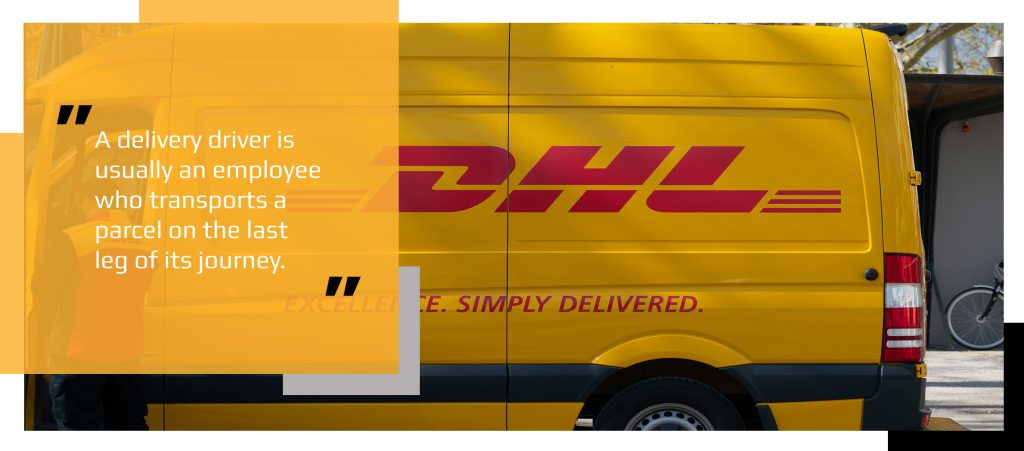
People sometimes use “courier” and “delivery driver” interchangeably. In logistics terms, a delivery driver is usually the person who completes the final leg (last‑mile delivery). The courier (the company/service) covers the entire process—collection, network movement, and delivery.
Parcel service vs courier service
This is where confusion often comes from. A parcel service (often postal) and a courier service both move parcels, but they’re built for slightly different jobs.
What is a parcel service?
A parcel service is typically designed for small, lightweight, individual parcels, including one‑off sends to family or occasional work shipments. Parcel services often apply tighter size/weight/commodity restrictions and may offer estimated delivery dates rather than specific time windows. Tracking can exist, but it may be less detailed than a courier’s real‑time scan events.
What is a courier service (in contrast)?
A courier service is usually a private carrier that can ship a broader range of items—from documents and standard parcels to heavier or bulkier shipments. Courier services often differentiate through speed (same‑day/next‑day), collection options, international coverage, more granular tracking, and add‑ons such as timed delivery or duty‑paid shipping.
When cost flips: why a courier can be a better value
Postal/parcel services can be excellent for straightforward, small parcels. But once you’re shipping bulky items, unusual shapes, or anything time‑sensitive, pricing and constraints can make a courier the more practical option—especially when you factor in collection, tracking detail, and service support.
Side‑by‑side: parcel service vs courier service
| Feature | Parcel service (often postal) | Courier service |
| Best for | Small, individual parcels; routine domestic sending | Time‑sensitive, higher‑value, bulky/heavy, or frequent shipping |
| Delivery timing | Often, an estimated day/date | Often offers faster options and can include timed or guaranteed windows |
| Collection | Often, drop‑off led; collection may be limited | Commonly offers collection and business pickup options |
| Tracking detail | Varies; can be less granular | Often includes multiple scan events and real‑time tracking |
| International handling | May be limited for express or complex routes | Typically built for international routes, it may assist with customs and import processes |
| Duties/taxes (international) | Often recipient pays on arrival (depending on the service) | May offer sender‑paid options (e.g. deliver duty paid) to reduce delays |
What do couriers deliver?
Most couriers deliver a wide variety of goods. The practical question is less “what can they deliver?” and more “what will they accept under their rules and the destination country’s rules?”
Common items couriers deliver
- Documents and paperwork that need reliable transit
- Standard retail parcels (clothing, accessories, books)
- Business shipments (parts, samples, spares, marketing materials)
- Some foodstuffs (subject to service rules and destination restrictions)
Common items couriers will not deliver
Every courier has a prohibited/restricted list. Obvious examples include illegal drugs and firearms, but exclusions can also cover items that are hard to insure, risky to handle, or restricted by law.
- Illegal drugs and controlled substances
- Firearms and weapons (and, for some services, bladed items)
- High‑value antiques or one‑of‑a‑kind artwork (varies by carrier and cover options)
- Live animals and human remains (specialist logistics exist, but standard courier networks typically won’t accept them)
- Aerosols, certain batteries, and other hazardous or pressurised goods (often restricted, sometimes allowed with conditions)
Country‑specific restrictions for international shipping
When shipping overseas, you must meet both the courier’s rules and the destination country’s import rules. If an item doesn’t comply, it can be returned, held, or destroyed by customs.
- Certain animal products (e.g. skins, furs, and horn products)
- Aerosol sprays
- Alcohol (rules vary widely by destination and carrier)
- Car batteries and other higher‑risk battery products
- Explosives and fireworks
- Weapons (including knives and similar items)
Dangerous goods: sometimes possible, but not ‘standard’
Some items are classed as dangerous goods (for example, lithium batteries inside electronics). These may be accepted only through services and procedures designed for that risk—including correct packaging, labelling and documentation. If a courier offers a dangerous goods option, it usually means staff are trained and processes align with relevant transport rules (such as IATA requirements for air carriage). Always check the exact acceptance criteria before you book.
Multiple parcels, heavy items and freight
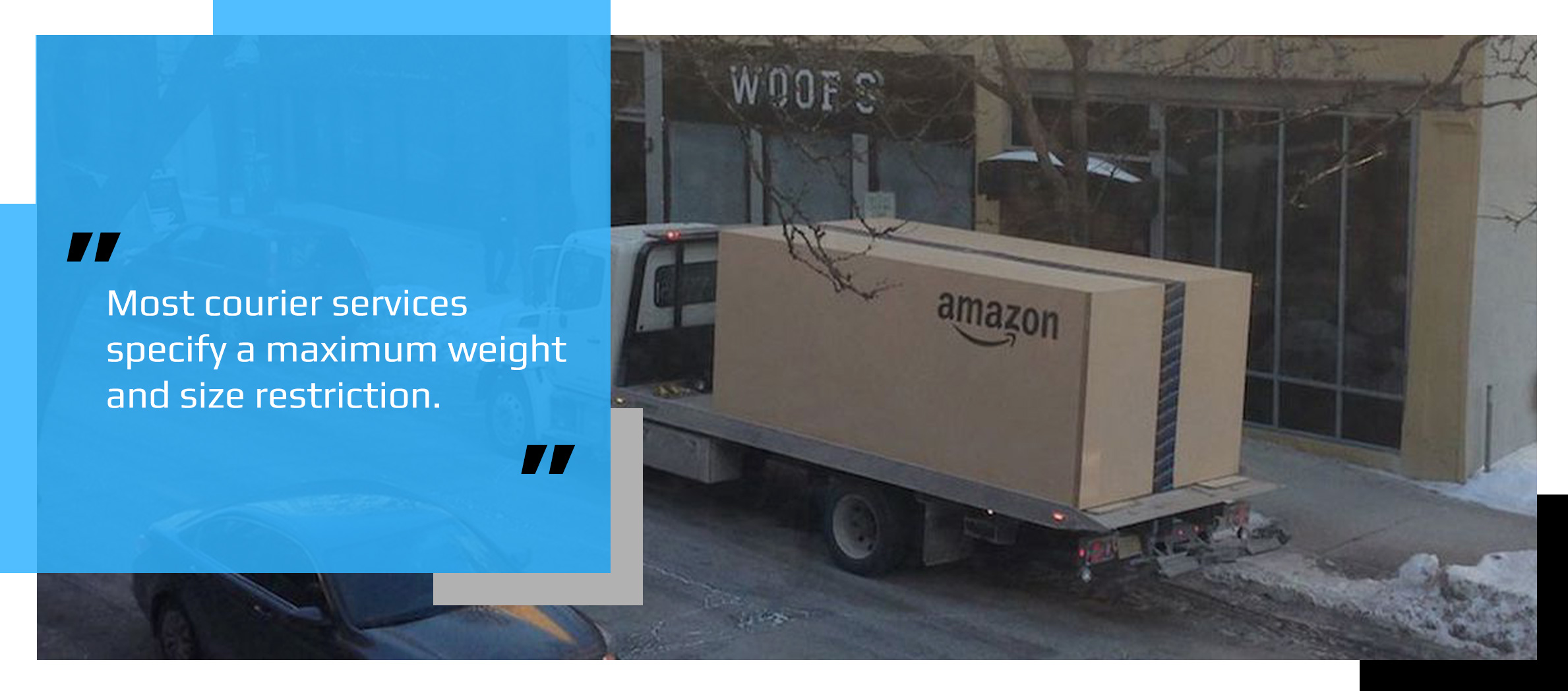
Courier networks can usually handle multiple parcels in a single booking (for example, several cartons going to one address). But a courier is not a removal service—very heavy items may need to be palletised and moved with different equipment.
As a rough guide:
- Parcels above around 40kg are often treated as “large”, and many standard services cap individual parcels below that.
- Some couriers cap single parcels at around 70kg on certain services.
- Domestic networks may accept much heavier shipments (including palletised consignments), sometimes up to several hundred kilograms, provided size and handling limits are met.
- Once you go beyond parcel handling limits, you’re usually in freight territory (road freight, air freight or sea freight).
Size, weight and the hidden cost drivers
Two parcels can weigh the same but cost very different amounts to ship. That’s because couriers price by actual weight and volumetric (dimensional) weight—whichever is greater.
Actual weight vs volumetric weight
Volumetric weight reflects how much space a parcel takes up in a vehicle or aircraft container. A common approach is:
Volumetric weight (kg) = (Length × Width × Height in cm) ÷ 5,000 or 6,000
The divisor varies by carrier and service. The practical takeaway is simple: bulky but lightweight parcels are often priced higher than you expect.
How to keep costs down without cutting corners
- Use the smallest rigid packaging that still protects the contents; unused space can increase dimensional weight.
- Keep items from shifting; movement causes damage and can also deform boxes (leading to surcharges).
- Measure accurately. Incorrect dimensions/weight can trigger re‑weighing, invoice adjustments, or delays.
International dispatch and customs delays
All international deliveries pass through customs processes. Not every parcel is opened, but many are screened (often by X‑ray) to identify restricted goods or anomalies. If customs holds a parcel, the cause is usually one of three things: the contents, the paperwork, or charges due.
Paperwork that commonly matters
- Accurate item description (what it is, what it’s made of, what it’s for)
- Declared value and currency
- Recipient and sender details
- Correct customs declaration forms where required (commonly CN22/CN23 for postal items, and commercial invoices for courier shipments)
How duty/tax payment affects delivery
For international shipments, duty and taxes may be billed to the recipient on arrival. Some courier services offer sender‑paid options (often described as “duty paid” services). Where available and appropriate, this can reduce delays caused by waiting for payment instructions from the recipient.
Choosing the right option: a practical checklist
Before you book, run through these questions:
- How urgent is delivery? (Same‑day/next‑day/standard)
- Is it domestic or international—and does the destination have special restrictions?
- What are the parcel’s exact weight and dimensions?
- Is the parcel of high value or hard to replace? (Consider cover/insurance and signature/photo proof of delivery.)
- What does it contain—could it be restricted (batteries, aerosols, liquids, alcohol, sharp items)?
- Will the recipient be available, or do you need a specific delivery window?
- Who should pay duties/taxes for international deliveries—sender or recipient?
When a parcel service is usually enough
- Small, low‑value items where exact timing isn’t critical
- Routine domestic sending where estimated delivery dates are acceptable
When a courier service is often the better fit
- Time‑sensitive shipments (business parts, documents, urgent replacements)
- Heavier/bulkier parcels where postal limits or pricing become restrictive
- International shipping where tracking details and customs support matter
- Higher‑value items where you want clearer scan events and proof of delivery
FAQs
What’s the parcel and courier difference in one sentence?
A parcel is what you send; a courier is the person/company that collects, transports and delivers it.
Do couriers deliver only parcels?
No—many courier networks also move documents, and some offer specialist services for larger or more complex shipments.
Do all parcels get scanned?
Not always. Scanning depends on the carrier and the tracking service you choose. Tracked courier services typically scan at multiple network points; untracked services may not.
Why does my parcel show “held at customs”?
Usually, because customs needs clarification (paperwork/value/description), the item is restricted, or duties/taxes are due. Tracking status updates should indicate the next step.
Can I send electronics with lithium batteries?
Often, yes—but only if the courier accepts them and the shipment follows the correct dangerous goods rules for packaging and carriage. Check acceptance and packing guidance before booking.
Is “parcel service” the same as “courier service”?
They overlap, but they’re not identical. Parcel services are typically built for smaller, routine sending; courier services often focus on speed, flexibility, tracking detail and international movement.
Courier services for businesses
Impact Express supports businesses that need reliable courier and logistics solutions in the UK and internationally. As a DHL Authorised Service Partner, we provide access to a wide range of delivery options — from express courier services and UK overnight delivery to international shipping services and specialist dangerous goods courier services.
If your business regularly sends parcels, manages customer orders, or needs help with international deliveries, our team can help you find the most efficient solution.
Get an instant quote online or speak to our team to discuss the best courier solution for your business:


